GST 2.0 and Tax Cuts: Can They Make Growth Fairer and Greener?


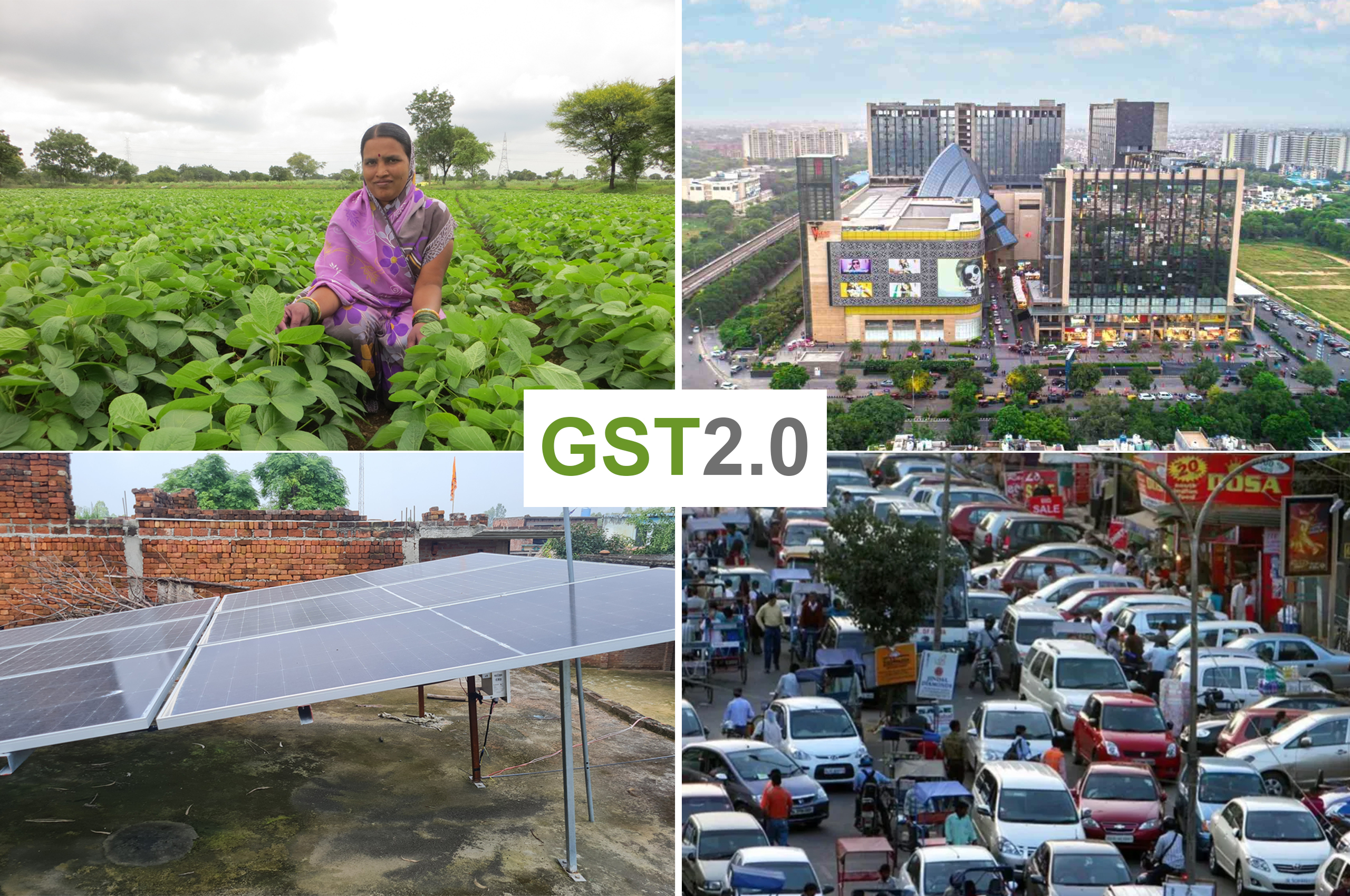
India’s latest GST reform, being termed as GST 2.0, is more than just slashing rates. By simplifying the tax structure, cutting levies on essentials, and supporting renewable infrastructure, it’s opening pathways toward inclusive growth and greener development. But if policies don’t focus on both equity and sustainability, growth can drift in the wrong direction — creating gaps and pushing communities onto very different paths of development. Let’s explore what this means.
GST as a Tool for Equity
GST 2.0 is already easing the financial burden on everyday essentials. Household items like soap, toothpaste, bread, and medicines now attract either 5% GST or no tax at all reducing costs for low-income households and broadening affordability of basic goods (Home – Goods and Services Tax Council | Goods and Services Tax Council). Much-needed relief is also visible in rural and agricultural sectors, with tractors and irrigation gear moving from a 12% to a 5% slab, cutting mechanization costs for small farmers. (Home – Goods and Services Tax Council | Goods and Services Tax Council)
This approach conveys a clear message: equity by design, not by accident. When subsidies and tax reforms reach the bottom of the pyramid, they help shift consumption toward necessities reducing inequality and ensuring that growth is not just trickle-down but bottom-up. For small farmers, these savings could mean reinvestment in production, better yields, and even financial stability.
GST 2.0 promises cheaper essentials, but its real test lies in whether it can drive inclusive growth. Today, rural MSMEs, the backbone of India’s economy often misses out on input tax credits due to compliance and digital barriers, while larger firms capture most of the benefits. At the same time, disability aids like prosthetics and wheelchairs still attract a 5% GST, effectively taxing inclusion. Future reforms that simplify digital filing, support formalization, and exempt essential aids can transform GST from a cost-relief measure into a catalyst for equity and competitiveness.
GST as a Lever for Sustainable Development
On the sustainability front, GST 2.0 advances positive signals. The GST Council has slashed tax on renewable energy components such as solar cells, biogas plants, windmill parts from 12% to 5% (The Economic Times). This alone is projected to lower capital costs for solar and wind projects by around 5%—translating to cost reductions of ₹0.10 per unit for solar and ₹0.15–₹0.17 for wind power. (The Times of India). These savings bolster financial viability, encourage domestic manufacturing, and potentially drive consumer benefits via cheaper electricity, reinforcing India’s renewable energy trajectory. Currently, solar power capacity in India stands at nearly 119 GW, with the target set at 500 GW by 2030 (Press Note Details: Press Information Bureau). The GST cut may well be the nudge needed to unlock more projects and drive decentralized energy solutions across India.
However, against this backdrop of intention, a paradox arises: GST’s broad cuts also make carbon-intensive goods like small cars, two-wheelers, TVs, and air conditioners cheaper moving from 28% to 18% slabs. (Home – Goods and Services Tax Council | Goods and Services Tax Council) While this boosts middle-class consumption, it risks undermining sustainability by encouraging higher fossil fuel use and reshaping lifestyles in ways that compromise well-being. Greater affordability of such goods can mean more time indoors, higher screen dependency, reduced physical activity, and reliance on artificial cooling rather than natural adaptation. Research links prolonged screen use to sedentary behaviour and rising obesity and anxiety rates, while studies on heat resilience show that over-dependence on cooling devices reduces natural heat tolerance, leaving people more vulnerable when access is unavailable (PMC; Arxiv). In effect, tax relief on these commodities may unintentionally lock households into unsustainable and less healthy consumption patterns.
Growth, Development, and Divergence
India’s growth trajectory now hinges on how GST 2.0 tax reforms are steered. If applied with intent, they can fortify the lower-income base driving inclusive spending on health, education, and livelihoods while simultaneously accelerating a green transition toward clean jobs and global competitiveness. Yet without this dual lens, the reform risks serving only conventional growth, skewed toward urban consumption, auto sales, and middle-class comfort rather than developmental equity or decarbonization. Economists estimate that the full pass-through of GST cuts could lower headline inflation by 0.5–1 percentage point, boosting purchasing power and consumption (HSBC India, ING Think), while also cushioning GDP growth by 0.3–0.5%, offsetting risks from global shocks like US tariffs (The Economic Times). These are critical advantages, but their true value lies in being channelled toward inclusive and sustainable development. Otherwise, GST 2.0 may simply amplify those already advantaged, sidelining the very goals of equity and climate resilience. India has the chance to rewrite this narrative if it wields GST not just as a fiscal tool, but as a value-driven instrument to build a fairer, cleaner future.
Featured Blog Posts



Get The Latest From The Social Sector In Your Inbox!

Subscribe to our newsletter