Maharashtra makes us see HER: Rewriting the rules for women in agriculture to transition them from Invisible Workers to Recognised Farmers


What do you see when you close your eyes and imagine a farmer? Invariably, a man, right?
Exclusion: Hiding in Plain Sight
But this is contrary to what data tells us. Globally, agriculture employed equal proportions (26%) of working women and men in 2025[1][2]. Yet, despite their comparable participation, women are far less likely than men to be recognised as farmers.
In India, nearly three-quarters (72.7%) of rural women who work are in agriculture, compared to only 47.8% of rural men who work[3].
So why do we fail to recognise women as farmers?
Names on the land records decide who can be counted legally as “farmers”, and most women do not own the land they farm on. According to Agriculture Census of India 2015-16, women are only about 14%[4] of India’s operational landholders, and likely a smaller share of legal owners.
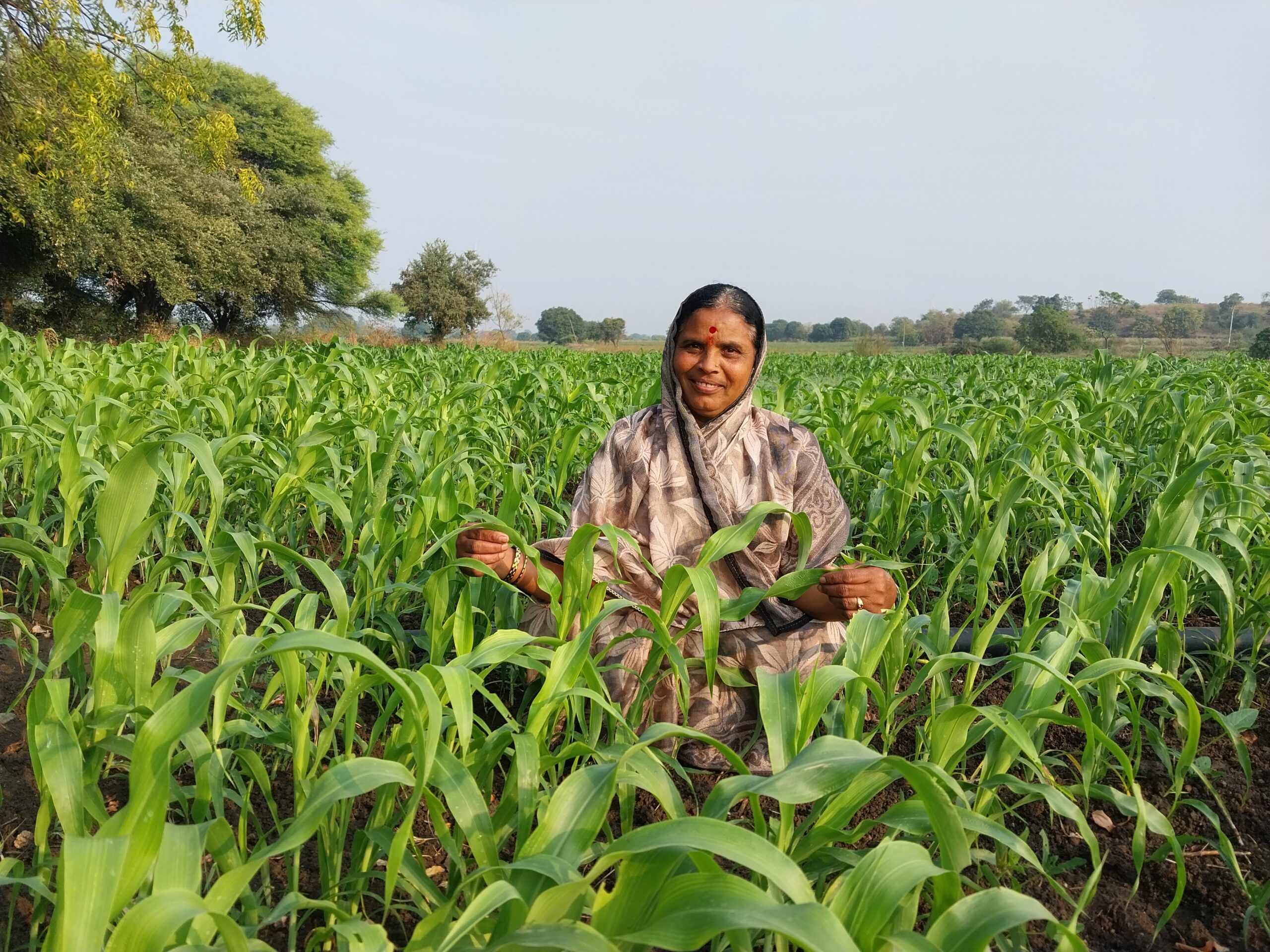
Meet Chandrakala Shelke from Dharashiv district, Maharashtra. For years, she grew soybean and Bengal gram on the family’s 2-acre land and took up daily wage labour on other people’s farms just to get by. On paper, though, she was not a “farmer” at all, as the land was recorded in her husband’s name, so the credit, insurance, and government schemes meant for farmers simply passed her by.
Despite women’s deep involvement in farming, this exclusion also limits their ability to decide what crops to grow, what inputs to use, where to sell, and at what price.
Men often make these decisions even when working outside their villages, while most women simply follow instructions. No wonder, when you closed your eyes earlier, you imagined a man as a farmer.
Maharashtra’s Landmark Shift
Maharashtra is now turning this narrative on its head, becoming the first state in India to take this step. Women no longer need to own land to be recognised as farmers. The landmark Women Farmers Empowerment Act, 2026 introduces Women Farmer Certificates (Mahila Shetkari Pramanpatra), granting women access to the entitlements, benefits, subsidies and services under the policies, programmes and schemes notified by the State Government.
The Act also has a provision for the State Government to formulate policies, programmes and schemes for the welfare of women farmers and their groups, including agricultural subsidies, distribution of seeds, fertilisers and other farm inputs, agricultural credit, crop insurance and extension services, facilitation of market access, transportation, storage and procurement of produce, and special assistance programs skill development and targeted support for single woman farmer.[5]
Women engaged in any agricultural or allied activities – crop production, livestock management, aquaculture, sericulture, vermiculture, poultry farming, horticulture, value addition, and more, can apply for the certificate using their Aadhaar number and Aadhaar-linked phone number. The process typically takes 15 to 30 days after approval granted by the Gram Sabha.
Now think back to Chandrakala. Under the old system, years of farm work earned her no formal recognition. With a Women Farmer Certificate in hand, women like her no longer needs land to be reassigned in their names before they can access credit, insurance, training, markets and government schemes in their own right – as farmers.
To implement this for thousands of Chandrakalas in Maharashtra, the Act mandates setting up the Maharashtra State Fund for Women Farmers, a Women Farmers Empowerment Council and Cell, and a State Monitoring Committee so that the scheme benefits effectively reach and get utilized by women farmers. This is particularly relevant for the state as although existing norms already call for at least 30% of agriculture scheme benefits to reach women, but in practice these have fallen short because benefits were tied to land titles which are overwhelmingly held by men. Maharashtra’s own Gender Budget Statement 2025-26 shows that barely 3%[6] of the Agriculture Department’s spending currently reaches women farmers.
While the Act marks India’s first state-level legislation to legally recognise women as farmers regardless of land ownership status, it also opens up an opportunity to link this new recognition with the National Mission on Natural Farming where the Government of India plans to drive adoption of natural farming through 70,000 women farmer leaders at the last mile.
A Decade of Groundwork by Swayam Shikshan Prayog
Our partner, Swayam Shikshan Prayog (SSP) has spent over a decade in Maharashtra putting into practice what the Act now makes law: recognising women as farmers and giving them the agency to make farming decisions. To do this, SSP enables women from smallholder families to gain cultivation rights on a small 0.25 to 0.5 acre of the family-owned land where women grow local food crops with natural inputs. They start taking decisions on what crops to grow, what inputs to use, what produce to use for family’s consumption, what to sell and where.
SSP handholds these women and their family members to gradually scale the practices over the entire land, and support adoption of agri-allied livelihoods in livestock rearing, vermiculture, food processing etc. SSP has now scaled their Women-led Climate Resilient Farming (WCRF) model to more than 2.75 lakh women farmers across four states in India transforming over 120,000 hectares of land from chemical-based to natural farming.
Recently, SSP hosted a national multi-stakeholder policy dialogue in Delhi to deliberate on how their WCRF model can serve as a structured transition pathway within the National Mission on Natural Farming implementation. The key takeaways are captured in the dialogue report, and if you want to go deeper, this publication explains how the model is positioned to bridge the last mile transition towards natural farming.
Since 2017, we at Re-emerging World (ReW) have been supporting SSP in designing, piloting, and scaling the Women-led Climate Resilient Farming model, and we believe that the Women Farmers Empowerment Act, 2026 will deepen the program’s impact in Maharashtra.
So, the next time you close your eyes and imagine a farmer, we hope you see HER too.
———————————–
To better understand SSP’s model, you can read some of our publications, which capture the women farmers’ journey and the impact they have experienced.
- This 2019 publication synthesises the WCRF model and its impacts.
- In 2021, we followed it up by documenting how to operationalise the model on the ground to inspire similar programs.
[1] World Bank, “Employment in Agriculture, Female (% of Female Employment) (Modeled ILO Estimate),” World Development Indicators
[2] World Bank, “Employment in Agriculture, Male (% of Male Employment) (Modeled ILO Estimate),” World Development Indicators
[3] Ministry of Statistics and Programme Implementation (MOSPI), Periodic Labour Force Survey: January-December 2025, Annual Report (New Delhi: Government of India, March 2026), Statement 8, p19
[4] ICAR-Central Institute for Women in Agriculture, Gender Disaggregated Data in Agriculture (Bhubaneswar, Odisha: ICAR-Central Institute for Women in Agriculture, 2023), p18
[5] Government of Maharashtra, The Maharashtra Women Farmers Empowerment Act, 2026 (Maharashtra Act No. XLVI of 2026), published in the Maharashtra Government Gazette, July 22, 2026, p6
[6] The migration story, Beyond recognition, the way forward for Maharashtra’s women farmers (Maharashtra, July 2026)
Featured Blog Posts

Get The Latest From The Social Sector In Your Inbox!

Subscribe to our newsletter