Scaling a Women-led Climate Resilient Farming Model across India through Pilots, Partnerships, and Policy Advocacy
 India

Client Ambition
Our client, Swayam Shikshan Prayog, a grassroots organisation empowering rural women, had spent nearly a decade developing a women-led climate resilient farming model in drought-prone Maharashtra. Under its one-acre approach, women farmers begin natural farming on a small plot of family land and expand gradually as confidence grows. SSP, supported by Oak Foundation, aimed to prove the model beyond Maharashtra, enable local partners to replicate it, and influence national policy on natural farming.
Our Solution
We partnered with our client as its knowledge partner over three and a half years, supporting programme design, progress reviews, and decision-making through regular programme management support.
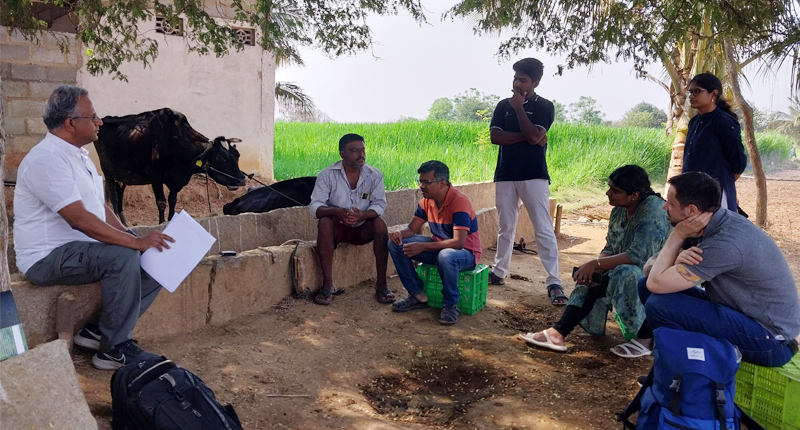
To build evidence from new geographies, we conducted action research in two pilot districts with contrasting agro-climatic profiles: semi-arid Bidar in Karnataka and high-rainfall Wayanad in Kerala. Engaging 84 respondents, including women farmers, community resource persons, local partners, and government officials, we profiled adopter segments, assessed government convergence and partner readiness, and recommended course corrections for the coming seasons.
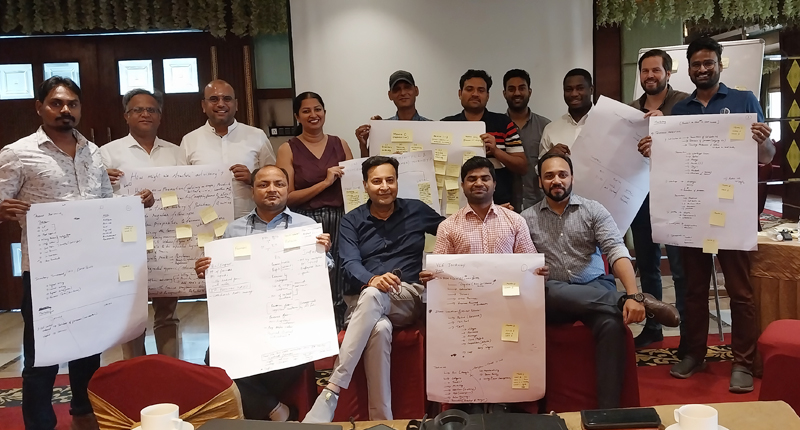
To help the model travel further, we designed and facilitated capacity-building workshops for five NGO partners, and led the development of fundraising proposals to support their own independent roll-out.
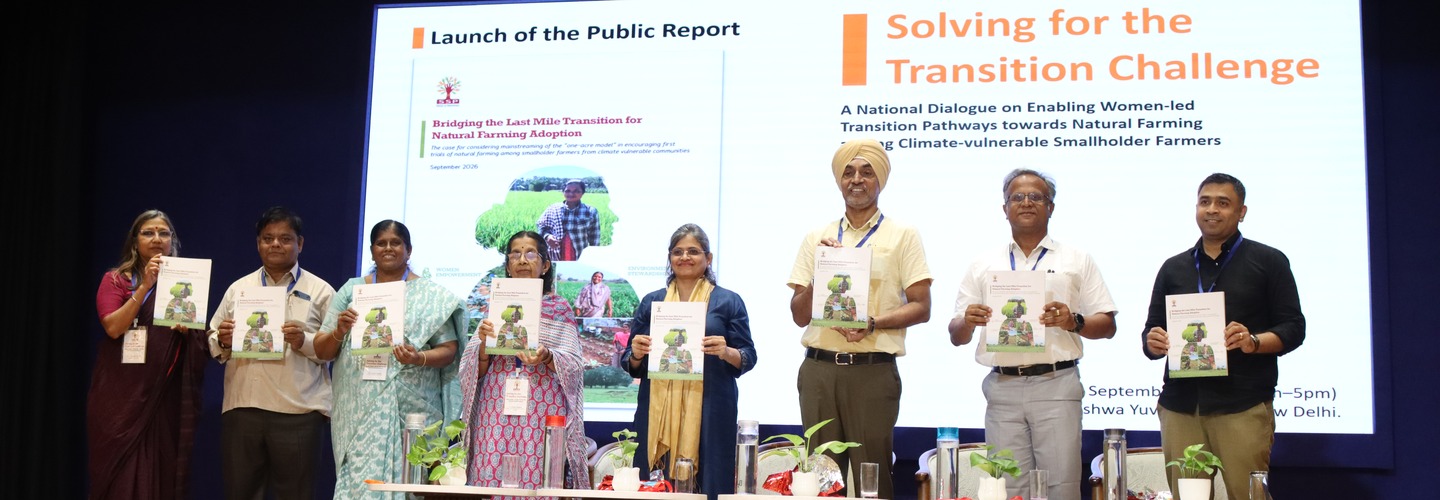
For policy advocacy, we led the research and development of a public report making the case for integrating the one-acre model into India’s National Mission on Natural Farming, with policy recommendations. We also supported the design and knowledge management of a national dialogue in New Delhi, where the report was launched, and synthesised key deliberations into an event report.
Results
The engagement helped the client reposition its model from a Maharashtra success story to a nationally relevant transition pathway for natural farming. The action research showed that the model’s core logic of starting small, women-led experimentation, and sustained handholding held in very different contexts. It also surfaced practical adaptations, such as kitchen gardens and homestead plots in land-constrained Wayanad, and gaps in livestock, irrigation, and seed access in Bidar, giving the client timely recommendations for course correction. Across the two pilots, 2,000 women farmers in 20 villages adopted the model. The partner workshops and proposals helped five organisations across four states prepare to adopt the model and raise funds for it. The public report, launched at a national dialogue with 61 participants from 24 organisations, including former senior government officials, researchers, donors, and women farmer leaders, positioned the model as a practical bridge to the last-mile transition gap in national natural farming policy. Overall, the engagement strengthened the client’s evidence base, partner network, and policy voice to scale women-led natural farming across India.
View Other Projects
Designing, pilot-testing and gradual scaling of agri and dairy input business through activation of milk collection agent network
Supported in designing and piloting a go-to-market strategy through small dairy led distribution and complementary channels – generating insights on farmer adoption, channel performance, and market expansion opportunities
India